Is Italy Safe? A Local’s Straight Answer for Travelers
We always write these notes with one particular reader in mind: you — someone who already loves Italy, or suspects they might, and is turning over the idea of actually coming. Their whole purpose is to put the knowledge of a lifelong local at the service of anyone who wants to see this country properly, rather than the flattened, one-size-fits-all version you get from a brochure. And few questions reach me more often than this one, from every kind of traveller, so I want to answer it as directly as I can: is Italy safe? The short answer is a clear yes. But a good answer needs a distinction or two and one plain premise first — and I am not going to leave anything out, not even the uncomfortable parts, because the point is not to reassure you into booking a trip and then let you be caught out on the ground. The point is exactly the opposite: that you arrive already knowing that yes, Italy is safe, and knowing the handful of specific things that keep it that way.
Let me set the premise with numbers, because they matter and they are reassuring. By any measure that can actually be counted, Italy is a safe country. Violent crime is genuinely rare here — the homicide rate is around half a person per hundred thousand, which is among the very lowest in the entire world — and the country sits comfortably in the more peaceful third of all nations on the Global Peace Index. Narrow it down to travellers specifically and the picture is, if anything, even calmer: serious crime against tourists is vanishingly uncommon, and on the numbers it compares favourably with France, with Spain, with Portugal. The overwhelming majority of visits pass without the faintest shadow of trouble. So what is there to manage? Not danger to your person — that is not the Italian problem, and I will not pretend it is. What there is, is opportunistic petty theft: a pickpocket in a crowd, a bag left carelessly open, a small and practised scam outside a monument. It is concentrated in precisely the crowded places every visitor walks through, which is the good news, because it means it is predictable.
The real question is not whether Italy is dangerous — it isn’t — but how to make yourself the traveller the pickpocket looks straight past.
The stations, and the streets around them
Every great city in the world has a few corners where you keep your wits a little sharper — London has them, New York has them, Paris certainly has them — and Italy, being no different from anywhere else in this, is no exception. Here those corners tend to be a handful of streets immediately around the main stations of the two largest cities, Rome and Milan. Take Rome’s Termini, the busiest railway station in the country, since it is the one travellers ask me about most often: is Rome Termini safe? Yes — and let me be precise, because the nuance is everything and the internet almost always gets it wrong, frightening people off the wrong thing entirely. Termini itself is safe. It is busy, staffed, watched over at every hour; you will notice police, you will notice the carabinieri, and very often soldiers as well, posted across the concourse and at the entrances — which is not a sign that something is wrong, but the very reason so little goes wrong inside it. Milan’s Centrale is the same story. It is not the station that asks for your care. It is that, just outside and immediately adjacent to these great hubs — a few of the streets around Termini among them — there are some tired, run-down blocks that are best avoided, and above all best avoided after dark. In daylight nothing happens there at all; you could walk straight through and notice nothing worth a second thought. At night, simply do not go wandering them on your own.
The practical rule almost writes itself, and it is an easy one to keep. If your train out of Termini leaves late in the evening, or you are arriving somewhere after dark, do not pick your way to or from the station on foot through unlit streets you do not know. Take a taxi, or take an Uber. The driver will set you down at the right door — the safe, busy one, where there is genuinely nothing to think about — and the entire question dissolves. And if you happen to be travelling with a guide or a tour leader, it dissolves before it is ever asked, because those of us who do this for a living know these cities street by street: we know exactly which way to walk out of Termini, and which way not to, at which hour, on which evening. I have started with the stations quite deliberately, and not to alarm you, but because in the big Italian cities they are the single most sensitive point there is — which is, when you turn it around, precisely why you will always find the law standing squarely inside them. Keep the one simple habit — by day entirely at your ease, by night a taxi or good company — and even this, the most delicate corner of the whole subject, quietly stops being a problem at all.
Pickpockets: real, and remarkably easy to disappoint
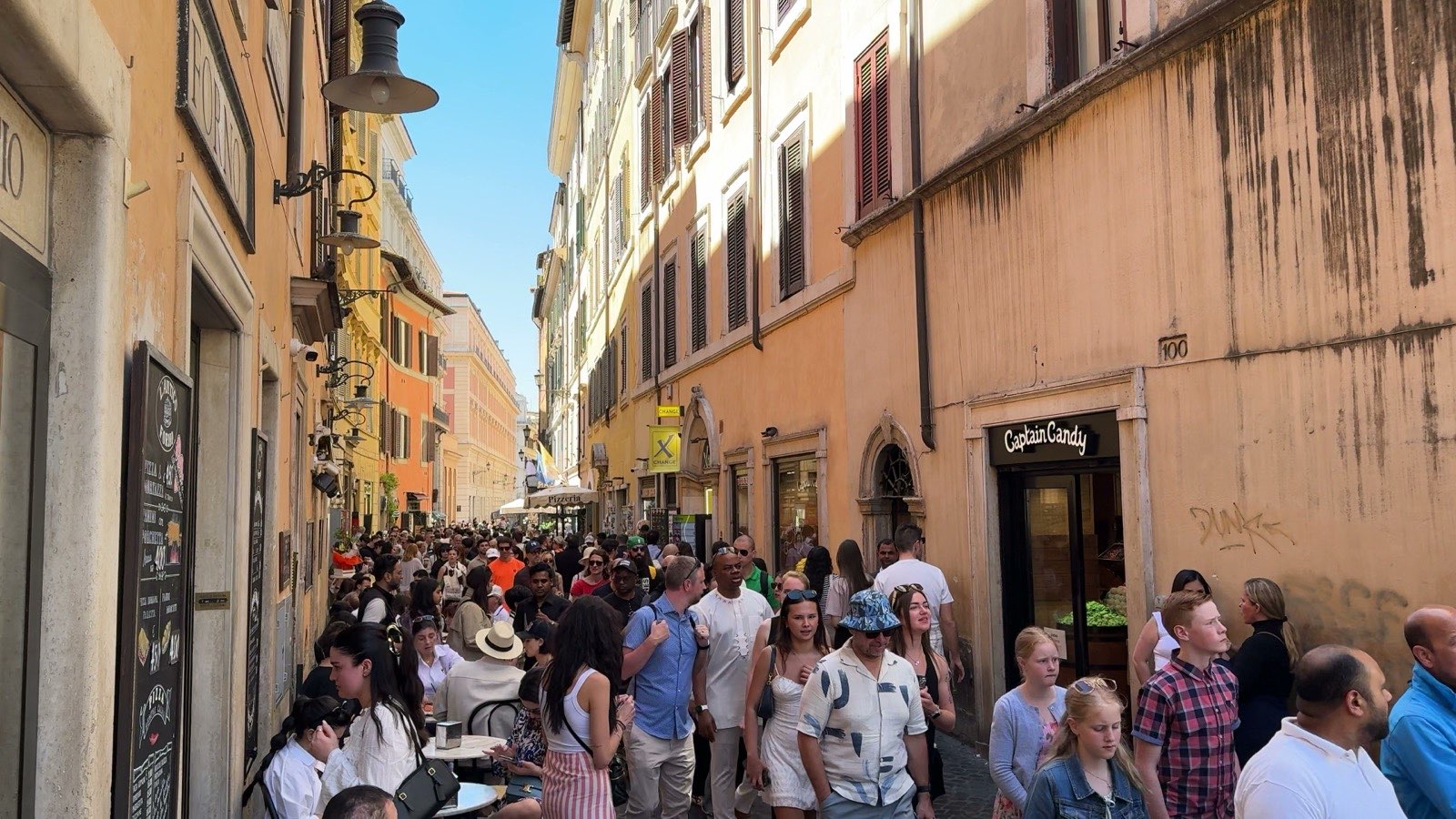
Now the chapter everybody has heard about before they ever land, and I will not soften it, because this one is true: pickpockets exist. They are real, they are here, and pretending otherwise would do you no favours at all. What you need to understand is where they work, because they are not everywhere — they are creatures of very particular conditions. They love a crowd, and they need one. So you find them in the squares in front of the metro entrances, on the metro carriages themselves and in the halls and passages beside them; anywhere a queue forms, anywhere a press of bodies builds up and slows down. In front of the Colosseum, around those same metro mouths where everyone is looking up and no one is looking down. In the perpetually thronged streets around the Vatican, where the crowd is so thick you can barely move. Wherever people are packed shoulder to shoulder and every last eye is fixed on the monument rather than on the pocket — that, for a pickpocket, is perfect weather.
And yet — and this is the part I most want you to carry with you — a handful of small, almost effortless habits are enough to have you quietly passed over and left completely alone, because a pickpocket is looking for the easy mark and has no interest whatever in the careful one. There is no need for money belts or paranoia; there is only the need to close the few small openings they actually exploit:
- A handbag with no zip, or one left gaping open — and this happens far more than you would ever think, not through foolishness but because in the excitement of a beautiful place people simply forget. Keep it closed.
- A backpack worn, as backpacks are, on your back. In a dense crowd it can be opened behind you without your feeling the slightest thing — or even slit along the bottom seam, which they genuinely do, so that the contents drop quietly into a waiting hand. In any real press of people, swing it round and wear it on your front, where your own eyes and arms are.
- A wallet, or your documents, carried in a back trouser pocket — and men, this one is aimed squarely at you, because it is so nearly a universal habit. Never the back pocket. The front, always.
- A handbag carried loose; instead, keep it tucked under your arm and held close in against your body, where it is a part of you rather than a target beside you.
That, genuinely, is the whole of it. You would not believe how many people, for one reason or another — tiredness, wonder, a phone, a map, a child’s hand — let their attention drift for a moment and leave a flank exposed, committing one of those few small mistakes without ever noticing. And it is exactly that momentary opening, and nothing more mysterious than that, which the pickpocket has spent all day waiting for. Close it, keep it closed, and you simply cease to be worth the attempt. They will move on to easier company, and you will never even know they were there.
The “gift” that isn’t: the bracelet sellers
There is one last dynamic I want to walk you through, and it is the one travellers fall for most often of all, for a simple reason: it does not look like anything to do with theft. It looks, at first, like warmth. Outside the big sites you will come across street sellers of bracelets, of little carved figures and trinkets, and their opening move is not a demand but a gift. It is a present, they will say, just a present — and quick as thought they will press the thing into your hand, or, more cleverly still, into your child’s hand, all the while waving away any suggestion that you might pay for it. You thank them, naturally, and you turn to go — and that is the precise moment it begins. Because now they come with you, following a step behind, asking for a little help, a little something, just a small kindness in return — because, after all, did they not just give you a gift? You may have no coins on you at all; it will make no difference; the insistence itself is the entire mechanism, and it can turn genuinely unpleasant, especially with children in tow and a crowd all around. And there is a well-worn variant to watch for: they will make as if to hand you the object and, at the last second, let it fall; you, being a decent person, bend to pick it up — and now they will not take it back, because it is yours now, you see, you are holding it — and the pressure for payment begins from there.
The defence, happily, is wonderfully simple, and it comes down to a single phrase and a single decision. When you see one of them peel away from the others and come toward you — all smiles, all warm greetings, an outstretched hand offering you a high-five — you do not get drawn in, and you do not, whatever happens, take anything into your hands. You look at them, you say plainly and pleasantly, “No, grazie,” and you keep walking. You do not engage, you do not stop, you do not slow your step; you simply keep to your own path and carry on. And what you will find, every single time, is that absolutely nothing happens. The whole thing depends on your pausing, and you have declined to pause.
I have walked you through these three dynamics in particular — the streets around the stations, the pickpockets in the crowds, the sellers with their “gifts” — because they are the most sensitive of the lot, and because they cluster in exactly the handful of cities you are most likely to be visiting. But hold on to the proportion of the thing, because it is the most important part: almost none of this is danger. Nearly all of it is friction — small, avoidable, faintly annoying friction — and friction of this kind dissolves the instant you understand how it works, which you now do. Attention, common sense, and open eyes are genuinely, entirely enough. Around the stations, and above all after dark, do not drift about alone — take a taxi, or go in company. And of course, having someone at your side on the ground who knows, street by street and hour by hour, what is where and what is what, lifts even that last small weight off your shoulders completely — which, when it comes right down to it, is a very large part of what we are here to do. So come. Italy is safe, it is more beautiful than you have been led to imagine, and now you know the few small things that keep it that way.
The right streets, the right hours, someone beside you who knows the city from the inside — so that safety is simply never something you have to think about, and you are free to enjoy Italy as it deserves to be enjoyed.
Request a free consultation →