Train Travel in Italy — A Straight Guide for First-Timers
I am going to be direct about trains, the way I am about everything — and I am going to tell you a few things that are hard to hear from most operators, unless they are genuinely local and have actually done the travelling themselves, over years, with their own luggage and their own family in tow. Train travel in Italy has real advantages and it has a few drawbacks; but managed well, and arranged in advance, it will cause you no real trouble at all. So let me start straight with the uncomfortable truth, work through it calmly, and at the very end tell you the single biggest risk you run when you take a train here — the one thing that catches almost everybody, and that almost nobody thinks to warn you about.
Here is the truth, then. In Italy there is a first division of train travel and there is a second — and, if we are going to be complete about it, a third. Some of our trains are genuinely comfortable, fast, modern and safe. Others you can rely on rather less. Now, let me be fair to my own country before I go on: to a local, to an Italian raised on this system and thoroughly used to our way of getting about, one or two of the things I am about to say will sound too strong, or simply beside the point — the ordinary business of a Tuesday that no one thinks twice about. But this article is not written for the local. It is written for the foreigner who wants to travel in calm and in safety — very often with the people they love beside them, an elderly parent, a husband or wife, small children and a pushchair — and who does not know our system, our bureaucracy, or the hundred small habits we absorb without noticing. Seen through that pair of eyes, freshly arrived and with a lot to keep track of, the line between the first division of Italian trains and the rest is a sharp one, and it deserves to be drawn plainly and without euphemism.
The trains I recommend without hesitation
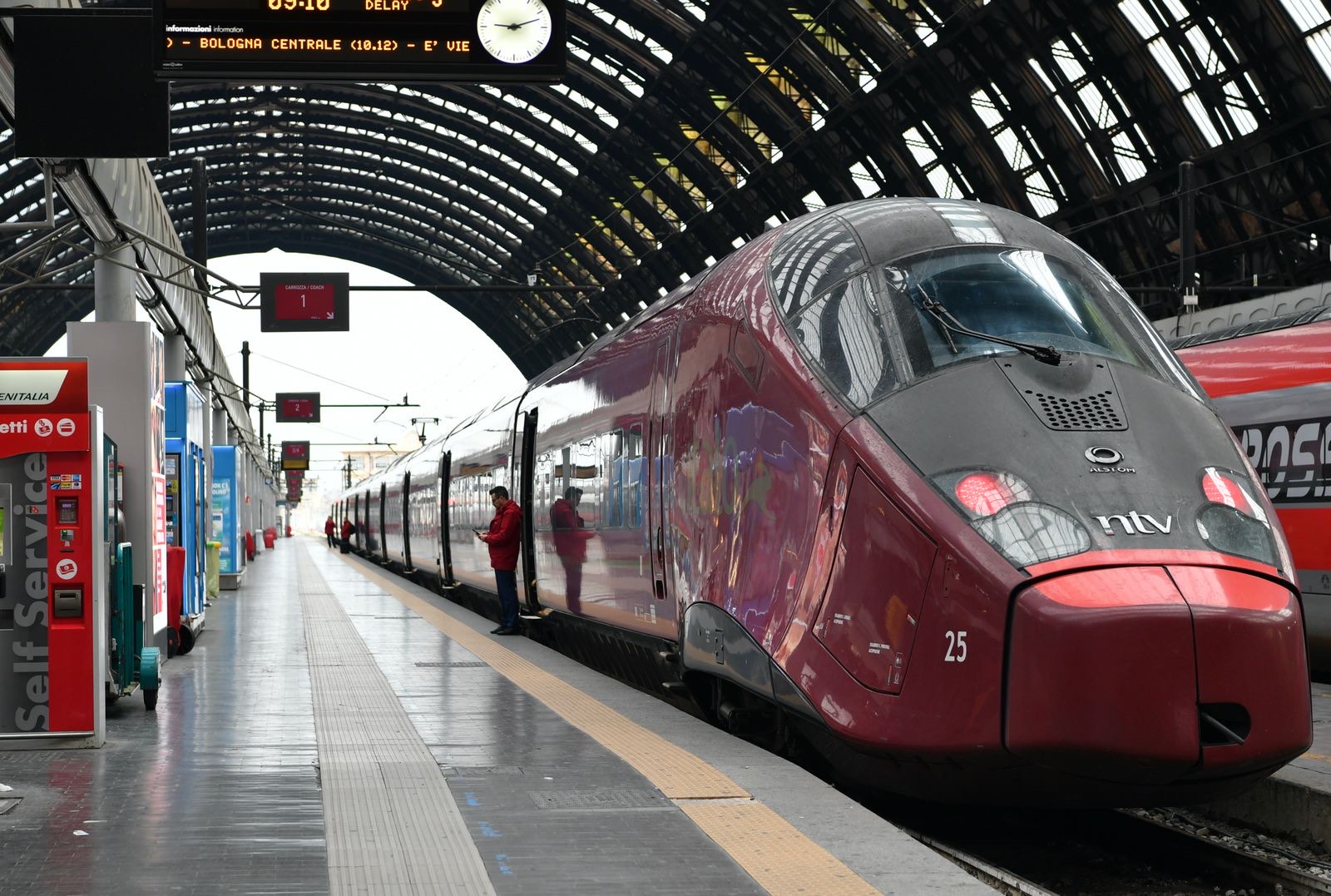
The best of them — the top, the ones I put in a class of their own — are the high-speed trains: the Frecce and Italo. The Frecce are the fleet of Trenitalia, the national railway, and you will come to recognise them by their colour. The Frecciarossa, the “red arrow,” is the fastest train in the country, running up to 300 km/h along its own dedicated high-speed lines; the Frecciargento, silver, reaches up to 250; the Frecciabianca, white, up to 200 on the more conventional track. Running alongside them, on the very same rails, is Italo — a separate, privately-owned company, every bit as fast, as clean and as modern, and in open competition with the Frecce, which is only good news for you. These trains are the summit of what Italy has to offer in comfort and in safety, and I recommend them to you with an entirely easy conscience — provided you keep in mind the one caution I have saved for the very end.
And please do not imagine you must spend a fortune on first class to travel well on them. Second class is perfectly good — more than good. You are looked after properly; the carriages are clean and quiet and filled, for the most part, with seasoned professionals, the kind of people who hold serious jobs and move between the great Italian cities for their work, week in and week out. By our standards the comfort is as high as it gets. Your luggage, too, is no cause for worry: there is no airport-style check-in and nothing to hand over — you simply keep your bags with you, sliding the smaller ones onto the racks above your seat and standing the larger cases in the dedicated luggage bays at either end of the carriage. And because the train is genuinely fast, it swallows real distances in a couple of hours and then sets you down not at some distant edge of the city, the way an airport does, but in the very heart of it — station to station, centre to centre, the cathedral very often a short walk from the platform. All of the principal cities are strung together this way. It is, in plain terms, a wonderful way to travel, and I am glad to send you onto these trains without a second thought.
Below the high-speed trains there are others that will also serve you perfectly well, and I do not want to leave the impression that everything beyond the Frecce is to be avoided — that is not the picture at all. The Intercity trains cover the longer hauls up and down the country, and they give a good, dependable service with a real measure of comfort and security. And the ordinary regionali — the regional trains — are, at least when it comes to the major cities and the busy central hours, reasonably reliable too. The distinction I am drawing is more particular than “good trains and bad trains,” and the particulars are exactly what a visitor needs to hear.
Where I would be more careful
Here is the part where I have to speak as someone who does this for a living, and who is a point of reference for the people who come to see our country — which means, precisely, that I cannot afford to tell you things by halves. For the traveller this article is written for — a foreigner, a visitor, and above all one who is travelling entirely on their own, with no operator quietly handling the arrangements behind the scenes — I would not, in good faith, put you onto just any train at just any hour of the day. The regional trains exist, and a great many of them are perfectly fine; but to use them well, and to use them comfortably, you really do need to know the particular line, its timetable, and the character of the service at that specific time of day. They are not all equally suited to every hour. On certain lines, and at certain times, the mix of passengers is not always what you would choose for a calm and untroubled journey with your family around you — and that is a real consideration, not a snobbery, and I am not going to pretend it out of existence simply because it is awkward to say. It touches a larger subject altogether, the general question of safety in and around Italian stations, and that deserves a careful article of its own rather than a hurried paragraph buried in this one.
We set ourselves up as a guide to this country — so we do not get to tell you only the flattering half of the truth.
So let me put the practical conclusion as plainly as I can. For a visitor travelling on their own, I recommend the first two categories only — the high-speed trains and the Intercity — and, above all others, the first. Choose the Frecce and Italo, lean on the Intercity where the route calls for it, leave the rest to the days when someone who knows the ground is arranging things for you, and you will have taken very nearly all of the uncertainty out of the day before it has even begun.
Book the fast trains ahead — and yes, you really should
This is one of the questions I am asked most often, so let me answer it directly, because the answer is a clear and simple yes. Book the high-speed trains in advance. It matters, and it matters more than most first-time visitors expect. There are two reasons, and they work together.
The first is a matter of price and availability. The cheapest fares on the Frecce and on Italo — the ones that make high-speed travel such good value — are released in limited numbers, and they go. As a train fills and the departure date draws nearer, the cheap fares sell out and the price climbs; and on the popular routes and the popular days — a Friday down to Rome, a summer Saturday to the coast — it is not merely the cheap seats that disappear but, now and then, the seats themselves. Leaving it to the morning of travel is how people end up paying three times what they might have, or missing the train they wanted altogether.
The second reason is the nature of the ticket itself, and it is worth understanding, because it is not how every country works. A high-speed ticket in Italy is nominative — it is issued in your name, valid only for you, and you may be asked to show identification that matches it. It is tied to one specific train, at one specific time, with one specific seat reserved and guaranteed for you. In other words it is a genuine, named reservation for a particular place on a particular departure, very much as an airline seat is — not an open pass you wave at any train that happens along. That is precisely why booking ahead is the right instinct: you are choosing your train and holding your seat, not taking your chances.
It is worth knowing, by contrast, that the ordinary regional trains work in exactly the opposite way — and this is the source of the single most common small fine visitors collect. A regional ticket is open: it is not tied to a named passenger or a particular departure, and you can buy it and use it on any regional train along that route. But for that very reason it must be validated — activated — before you board, in the little machine on the platform or the concourse (or, these days, within the app at the moment you buy it). Skip that step, and even with a perfectly good ticket in your hand you can be treated as travelling without one. The high-speed trains ask nothing of the sort: your reservation is already tied to your train, and there is nothing to validate. But the humble regional ticket does, and it is worth the ten seconds it takes.
The one thing that catches everyone: the platform change
And now the caution I promised you at the start — the single biggest risk you run, and the one that is most underestimated, precisely because in most other countries the stations run in a more orderly and more predictable way, and you simply are not conditioned to expect it. In the great Italian stations — Rome, Florence, Bologna, Milan — it is not especially rare for the platform of a train to change. For the trains I have recommended to you it happens almost never, because as a rule they are given the same platforms; but in a great terminus station — a stazione di testa, a “dead-end” station like Rome or Milan, where the tracks run in and stop against the buffers — a change can materialise at the very last moment. And so my advice, earned the hard way, is this: right up until you can physically see your own train standing there at its platform, keep your attention fixed on two things — the board, and, above all, the voice.
The board itself may well be perfectly correct: the new platform appears on it suddenly, updated in real time, exactly as it should. The trouble is that a traveller can be distracted — tired from the road, minding the luggage, keeping an eye on the children — and simply never notice the number quietly change. That is the whole reason the voice matters more than the board. In an Italian station the loudspeaker always accompanies a platform change with a spoken announcement — “Attenzione, cambio binario…,” attention, change of platform — naming the train and calling out its new track aloud across the concourse. So learn those two words before you go: cambio binario. When you hear them, look up. That one small habit — watching the board and keeping an ear open for the voice, right until your train is standing in front of you — is the most useful single thing I can teach anyone who wants to travel Italy’s railways in real confidence.
And that, really, is the whole shape of it. The trains here, chosen well and booked in good time, are a pleasure and not a worry: fast, comfortable, safe, dropping you into the middle of one beautiful city after another, the whole country unrolling past the window while you sit still with a coffee and watch it go by. The drawbacks are few, and every one of them dissolves with a little foresight — the right train, booked ahead; a familiar station; an ear open for the voice on the platform. Do that much, and the train stops being one more thing to be survived and becomes, exactly as it ought to be, simply a part of the journey.
The right trains, booked ahead, the connections that genuinely work and the stations you needn’t worry about — quietly taken care of before you arrive, so the travelling itself is calm from the first morning to the last.
Request a free consultation →